As Tompkins says and forshadows, he didn’t have until this point someone that caused problems to his strategy. Everything was going perfect, the members of his crew were the best and deadlines were fine, but, where is the challenge? In this story, it has a name: Minister Belok. Today I’ll be talking about chapter 11 of The Deadline, by Tom De Marco.
Turns out the NNL went out to a trip that will take long, so he put his finances director in charge of the project led by Tompkins. As a financial guy, he decided to cut the time in the deadline of the project and decided to merge the separate teams working on the same project in order to «maximize output in less time». As seen in the past chapter, this would not be the case, as aggregating people into a team costs effort and time in unification.
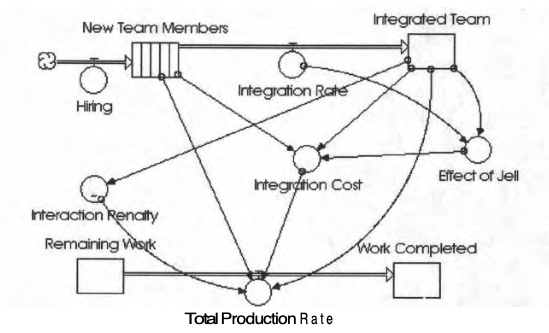
So how will Tompkins be getting out of this one? Simple, by playing to his rules. Since he is powerful, they had to obey his demands, but Mr. T devised a solution: they would merge all the teams, but form another two teams with extra members, the ones that aren’t doing anything related to the project led by general Markov. This would be the ultimate experiment: getting a team of the best engineers all together and overpopulated, vs normal engineers that will work in less quantities.
As seen by the predictions using Abdul Jamid’s method of modeling, the smaller teams would finish first, but let’s see what happens. It was time to spice things up, that is why I liked this chapter. We learn about politics, in this case pathological politics, the ones that make things worse every time. They form from anywhere, and can turn an organization’s goals into some else’s power and reputation goals.
Welcome readers, this time we’ll continue to cover the book of The Deadline, by Tom De Marco, and as I suspected last article, this new chapter grants us with new information to learn from. Tompkins meets a man called Abdul Jamid, a young man that is very talented in data analytics regarding project management.
He meets Mr.T in Rome while he was out for some personal business affairs. There they ate together and talked about the same subject Tompkins brings: you guessed it, the Morovian project management laboratory. This time the new stuff that this random character brings to the table is a way to turn the subjective into objective: hunches into a simulation.
Every project manager that has experience has its personal feelings, they are their instinct of experience that helps them to make decisions. The truth is that they are 100% subjective, as there are no ways to clarify if those personal hypotheses were true at the end. What Jamid taught Mr. T that evening was a sort of pre-machine learning process to make a model that simulated one of those feelings involved in PM.
After developing a sort of flowchart in which the model is represented the manager has to test it and refine it, along real case scenarios. The more info you feed it with, the more ways it will simulate the real hunch. It is sort of machine learning, but human made. Finally, you can use this tool to compare an initial hunch with real results at the end, thus verifying or rejecting the proposed version of the model.
This could be a useful to use, when refined of course. Instead of waiting for a hunch to be true or false, you could instantly know if you hypothesis is correct or not, and save losses in the way. Tompkins is now armed with a series of powerful weapons that each chapter gave him, so he better succeed in this project. I’m thrilled to see what happens next.
Times are weird in this era, as a giant pandemic known as the COVID19 struck the world violently. There is currently no cure to this new disease and could be life threatening for the older people. Businesses are starting to close, all mass events, in which people are seriously in danger of contracting the virus, are getting canceled all over the world. What started as a local problem to the Chinese government is now a responsibility for all.
Even though things are closing and people cannot leave their homes, economy is still running and you must pay your bills at the end of the month, so how in the world are going to get past this series of tragic events? Home office is the answer. Many companies and organizations are already in transition for the times to come until COVID-19 is contained. If you have a hard time with working in solitude at home, you are in luck this time around!
I worked for Apple Education for over 2 years and I’ll tell you one thing: I almost never saw my work colleagues and I was the only responsible person for my job in my workplace. I worked for the Campus Rep program, in which one student is selected to represent the brand in their university and find ways to make exposure to Apple’s core education initiatives. I’ll tell you about how I worked remotely and at the end I’ll throw some useful tips for working and managing inside your home.
When I entered the job I only had one physical event to attend: a massive training course given at Mexico City, in which all 40 members of the program, including leaders and managers, came together to ensure that everyone was well prepared for the job. Only 5 days I saw the team and the rest of the semester I worked at my university. Every activity I planned was physically unsupervised, I arranged my work schedules, and only once per week I had a meeting with my manager. Turned out this freedom granted me flexibility and space to enjoy all the things I like in life, along with work.
After a year in the program, the team lead saw potential in me, so he decided to invite me to work as a Senior Campus Rep, which are the managers that hold the program together. I was very excited, and as in my last position, I learned even more about remote communication and managing from anywhere. I now was the one who had a team on my back, and I was to ensure that they were trained, motivated and had the right strategies for getting successful at their universities, while I was also working on my projects at Tec de Monterrey.
Sounds like a very complicated job, but once I figured out the strategies for working remotely, I managed to get my team on board, get excellent results and still have time to spare for personal activities. Here are the five most important things that I learned during my job at Apple:
1- Be responsible with your tasks
As always, a great power comes with a great responsibility. Having to be all the day at home can be refreshing, because you can enjoy time with your family, practice a personal hobby, or sleeping spare time. I’ll tell you one thing: you must be very well organized with your times, because distractions are everywhere and there is no boss to tell you to get to work. You must be your own boss and get the job done in time and form.
2- Bond with your team, even remotely
My team was the best in the whole program for one simple reason: we were friends, even if we lived in different cities and never saw physically. I spent a lot of time in team meetings where we could do fun activities together, know each other, and get the chance to build trust and bond. I think this is equally as important as job related meetings, so have your spaces reserved for these type of meetings.
3- Think different
Not everything in work has to be the way traditional companies project it: boring, repetitive. Instead, play by your own rules and have fun in the process. Each week we had a different theme in which we would work on: one week we were the avengers and in our team meeting we had to dress up like a superhero, or in another we were members of the royalty, so our communication would have to be with the nicest manners and traditions. We all can change the way we do things to enjoy them more. Question yourself: How can I turn this boring activity into an enjoyable one with one simple change?
4- Overcommunication
As also told in last episode of CBC’s Spark, over-communication is essential for good quality work. We tend to suppose that people already know certain things about a deliverable, or that we will work in this certain way, but the truth is that the clearer the message, the better the flow of the team. Also, you must ideate a place for storing all the documents in the cloud, so that everyone in your team or organization can have access to it without making an extense journey searching for a file.
5- Plan before virtual meetings
Just as this applies in real life scenarios, we can speed up the time in which we meet a person by thinking ahead. Plan a list of topics that you want to cover during your meeting, during your work plot questions and in the meeting take them out to clarify them. This will hit on wasted time because if a conversation about something is over we move to the next thing on the list. This strategy can also be applied to discuss more topics in the same amount of time that you are used to.
Perspective is everything when looking at the world: we, humans, have the power to decide on everything in our lives. Every situation you are placed on, was in part your decision, so there are not excuses for passing a hard time working at home. I hope that with these strategies you can extend your productivity with the home-office method and also enjoy it as much as working close to your colleagues.
In this chapters Tompkins learns about an odd manager: a retired Morovian general.
Two very interesting chapters with tons of value to learn from. The Deadline by Tom De Marco is getting more weird in these new chapters. The eight chapter begins with Lahksa telling Tompkins that they are going to meet a very important person: the eminent Dr. Rizzoli. He is a researcher and famous investigator for a lot of fields in project management. Fooled by morovian techniques, he thinks he is going to arrive in Latvia for a conference he was giving, but at the end he landed on Tompkins’ home.
In between breaks, both managers spent a lot of time together and had the opportunity to discuss the current tech project in Morovia. The biggest highlight that Rizzoli gave to Tompkins was at the field of risk management. He said that it is an excellent way to prevent wastes in production time, because risks are everywhere and managers have to keep them tracked. He suggested that he should create a document with all found indications of risks, write how they are triggered, when is possible that they can materialize and the cost they could have. This organizer is a perfect tool for decision making.
At last, they agreed on finding an efficient way to transport the bad news throughout the teams and projects. Sometimes people are ashamed and scared of telling the bad news, but if the problem is not reported at the right time it will snowball towards risks showing up. Tompkins was very motivated with this talk and was ready to apply it at the various projects he is in charge of. Time to say goodbye to Dr. Rizzoli.
Don’t worry, another interesting character arrives in the next chapter: general Makrov. They meet him and find out he is a retired morovian military general, and unlike his fellow partners who went outside the country to enjoy life’s pleasures, he stayed to work as manager of all engineers at work in the island. Controling a group of people THIS large is not an easy task, so Tompkins was eager to learn from him.
He learned four important things that day: first, that you need to find meaningful work to your employees, this decision will increase your productivity and motivation. He also learned that if a manager detects a current effort will be a loss no matter what strategy he uses, it should be cut off as soon as possible. It is part of a good risk management analysis. Then, he told him that in the phase of team creation, it is better to use an already jelled up team instead of forming a new one because they already are in sync and ready to work. One of the final project deliverables should be a jelled team. Finally, he became aware of the value of time, and found that a day lost in the beginning has the same weight as one day lost at later stages of a project.
Although short, these chapters gave us, the readers, and Tompkins invaluable knowledge that can be instantly applied to our projects. I’m looking forward next chapters and what they can offer. The last thing I will say is that «Rizzoli a la Makrov» sounds like an excellent Italian Russian-esque dish name. See you next time!
This time I wanted to try something different to reflect the most important ideas on chapters 6 and 7 of The Deadline, by Tom De Marco. I made a song about it. No more needed to say.
WE’LL BE COVERING CHAPTERS 6 AND 7 AND LISTEN, THEY HAVE GOOD STUFF LIKE REAL GAME CHANGERS So DJ, DROP THE BEAT
TRUST YOUR GUT LEAD WITH HEART SMELL BULLSHIT BUILD A SOUL
Listen up here’s the deal for the chapter six Tomkins learns about making a good community Big surprise, a plot twist, Belinda’s added to the mix A pro manager that retired, what an opportunity
He meets her, then they talk, he asks her advice Belinda has a secret set of rules for managing Trust your gut, lead with heart, smell that bullshit on the rise Build a soul within the team that you are handling
Mr Tompkins and Belinda, Belinda Best managers in Morovia, Morovia Mr Tompkins and Belinda, Belinda Best managers in Morovia, Morovia
¿Did you think I was done? Chapter seven here we go T and B are searching for new managers in the nation Analyze each profile, interviews they undergo They hire five new guys and on the way find good information
Mr Tompkins and Belinda, Belinda Best managers in Morovia, Morovia Mr Tompkins and Belinda, Belinda Best managers in Morovia, Morovia
Managers must track all the info surrounding them To make strategies and end the war before even begins Listen more than you speak, ask for pointers with the staff Make first project easy, next one increase people in their charts
Mr Tompkins and Belinda, Belinda Best managers in Morovia, Morovia Mr Tompkins and Belinda, Belinda Best managers in Morovia, Morovia
Now you’re experts in project management Next time we’ll see more PM challenges There are still more lessons upcoming In the meantime DJ DROP THE BASS
Tomkins continued his adventure in the mysterious land of Morovia, and it turned out more crazy than before. This is the second part of my «Deadline» by Tom De Marco blog reflections. If you are interested in the first part, where I talk about the first two chapters, visit to my entry: «Management’s Wonderland».
Chapters 3, 4, and 5 set up the structure in which the whole book will likely be presented: a special situation in Tomkins’ journey that he faces and analyzes at the end, drawing important conclusions regarding project management.
Chapter 3 introduces life in Morovia, how Tompkins will be involved and what his job will be. Turns out the leader of this strange land settled a zone called «Silikon Valejit», where hundreds of excellent software engineers were hired to produce 6 important projects. The main goal is to be one of the biggest software exporters by the year 2000 (this book was written in the 90’s).
Chapter 4 starts with Lahksa giving Tompkins a journal, with the first entry being some advice he gave out years ago in a seminar: The essentials of Project Management:
Get the right people
Match them to the right jobs
Keep them motivated
Help their teams jell and stay jelled
The rest of knowledge is Administrativa, according to our main protagonist. They visit a man called Mopoulka, who is the lead behind one of the six projects: a CD-ROM plant that can produce all software products they will sell massively. Tompkins finds out that they were late development, but the reason why was that the lead was scared. Morovian dictator, called the NNL, threatened him to finish the project in a very short amount of time and with a fixed plan.
Tompkins then analyzes the strategy and finds that the plan must be changed for it to be a success, but the lead didn’t do anything because of fear. This gives us the main lesson of the chapter: people won’t embrace chance unless they feel safe. If a person feels in a good place to work, safe from harm, will likely work better and take risks in order to get the job done.
In the opposite scenario, where a manager threatens their people, everything will likely fail. This is the lesson of chapter 5, which introduces the NNL, and we discover that he was a US software engineer that bought THE WHOLE country of Morovia with his great richness from stocks. He clearly doesn’t have managerial skills, but Tompkins is here to save the day (or the project). Another important lesson is that if you don’t give people a reasonable amount of time for a project, it will likely fail also (unless you’re the infamous Steve Jobs and have abilities to distort time and space with ridiculous deadlines).
This story is beginning to kick off, and the content that I learned until this point is essential and very important. We will see what next chapters bring to the table.
Recently I started reading the book «The Deadline» by Tom de Marco, and I want to share my thoughts and opinions about the first and second chapter. This book was published in 1997 and it’s main inspiration is 1930’s Mr Tompkins in Wonderland by George Gamow. De Marco applied the same principle as the original novel, which was teaching physics by using a character that confronted important situations regarding laws of physics in a fictional universe. This time, the character is named the same, but the story focuses on a fictional world of Project Management lessons.
A quick summary of the first two chapters (SPOILERS): Tompkins is attending a seminar for people who are recently fired and preparing for finding a new job. He is a veteran project manager with plently of experience. He doesn’t seem to enjoy this seminar and passes most of his time asleep, but one evening a lady sits next to him. He discovers she is a secret agent of Morovia and kidnaps him using a modified version of his favorite coke. He now must help a government in a project management mission.
Still drugged and dreaming while traveling to Morovia, he sees a seminar given by Edgar Kalfbfuss, a young, unexperienced PM who only wants to see hard skills of the discipline. Tompkins confronts him and asks him: «Is that the whole agenda?» Kalbfuss, defensive, tells him that soft skills are easy to learn, and that is the reason he only covers those topics. Tompkins reminds him that human relations are just as important to successfully manage an organization, so his course should be named «Administrativa». He then wakes up and the dream was over.
In my opinion, Tompkins is right: if you don’t know how to motivate people, how to teach them to do their work right, how to build teamwork, your job will likely be very hard. It is a common area that people, specially software engineers, often give less importance. This story has now my attention, it has an interesting plot, and I’m looking forward to see what comes next in the next chapters. I will keep updating with new entries on this novel, so see you in the next one!





 Parra's Project Management Blog